반응형
아래의 모델들로 vocab size에 따른 분류 성능을 비교해보는 실험을 했다.
- Multinominal Naive Bayes
- Support Vector Machine
- Gradient Boosting Classifier
- Logistic Regression
- Complement Naive Bayes Classifier(CNB)
- Decision Tree
- Random Forest
- Voting
- 1-D CNN
라이브러리 및 데이터 로드
import matplotlib.pyplot as plt
import numpy as np
import pandas as pd
from tensorflow.keras.datasets import reuters
import time
from tqdm import tqdm

# Sklearn(ML) 관련 라이브러리
from sklearn.feature_extraction.text import CountVectorizer
from sklearn.feature_extraction.text import TfidfVectorizer
from sklearn.feature_extraction.text import TfidfVectorizer
from sklearn.naive_bayes import MultinomialNB, ComplementNB
from sklearn.svm import LinearSVC
from sklearn.ensemble import GradientBoostingClassifier, RandomForestClassifier, VotingClassifier
from sklearn.linear_model import LogisticRegression
from sklearn.tree import DecisionTreeClassifier
from sklearn.metrics import accuracy_score, f1_score

# TensorFlow/Keras(DL) 관련 라이브러리
import tensorflow as tf
from tensorflow.keras.preprocessing.text import Tokenizer
from tensorflow.keras.preprocessing.sequence import pad_sequences
from tensorflow.keras.models import Sequential
from tensorflow.keras.layers import Embedding, Conv1D, GlobalMaxPooling1D, Dense, Dropout
from tensorflow.keras.utils import to_categorical
# 데이터 로드
(x_train, y_train), (x_test, y_test) = reuters.load_data(num_words=None, test_split=0.2) # num_words 일단 미지정
# word index 사전
word_index = reuters.get_word_index()
# 0, 1, 2는 pad, sos, unk 토큰이므로 이후의 토큰들에 대해 3을 더해줘야 한다.
index_to_word = {index + 3 : word for word, index in word_index.items()}
index_to_word[0] = ""
index_to_word[1] = ""
index_to_word[2] = ""
# 디코딩
def decode_review(encoded):
return " ".join(index_to_word.get(i, "") for i in encoded)
train_texts_all = [decode_review(seq) for seq in x_train]
test_texts_all = [decode_review(seq) for seq in x_test]
# sample 확인
print(train_texts_all[:3])
print(test_texts_all[:3])
['<sos> mcgrath rentcorp said as a result of its december acquisition of space co it expects earnings per share in 1987 of 1 15 to 1 30 dlrs per share up from 70 cts in 1986 the company said pretax net should rise to nine to 10 mln dlrs from six mln dlrs in 1986 and rental operation revenues to 19 to 22 mln dlrs from 12 5 mln dlrs it said cash flow per share this year should be 2 50 to three dlrs reuter 3', "<sos> generale de banque sa lt genb br and lt heller overseas corp of chicago have each taken 50 pct stakes in factoring company sa belgo factors generale de banque said in a statement it gave no financial details of the transaction sa belgo factors' turnover in 1986 was 17 5 billion belgian francs reuter 3", '<sos> shr 3 28 dlrs vs 22 cts shr diluted 2 99 dlrs vs 22 cts net 46 0 mln vs 3 328 000 avg shrs 14 0 mln vs 15 2 mln year shr 5 41 dlrs vs 1 56 dlrs shr diluted 4 94 dlrs vs 1 50 dlrs net 78 2 mln vs 25 9 mln avg shrs 14 5 mln vs 15 1 mln note earnings per share reflect the two for one split effective january 6 1987 per share amounts are calculated after preferred stock dividends loss continuing operations for the qtr 1986 includes gains of sale of investments in enron corp of 14 mln dlrs and associated companies of 4 189 000 less writedowns of investments in national intergroup inc of 11 8 mln and brae corp of 15 6 mln reuter 3']
['<sos> the great atlantic and pacific tea co said its three year 345 mln dlr capital program will be be substantially increased to accommodate growth and expansion plans for waldbaum inc and shopwell inc over the next two years a and p said the acquisition of shopwell in august 1986 and waldbaum in december helped us achieve better than expected results in the fourth quarter ended february 28 its net income from continuing operations jumped 52 6 pct to 20 7 mln dlrs or 55 cts a share in the latest quarter as sales increased 48 3 pct to 1 58 billion dlrs a and p gave no details on the expanded capital program but it did say it completed the first year of the program during 1986 a and p is 52 4 pct owned by lt tengelmann warenhandelsgesellschaft of west germany reuter 3', "<sos> philippine sugar production in the 1987 88 crop year ending august has been set at 1 6 mln tonnes up from a provisional 1 3 mln tonnes this year sugar regulatory administration sra chairman arsenio yulo said yulo told reuters a survey during the current milling season which ends next month showed the 1986 87 estimate would almost certainly be met he said at least 1 2 mln tonnes of the 1987 88 crop would be earmarked for domestic consumption yulo said about 130 000 tonnes would be set aside for the u s sugar quota 150 000 tonnes for strategic reserves and 50 000 tonnes would be sold on the world market he said if the government approved a long standing sra recommendation to manufacture ethanol the project would take up another 150 000 tonnes slightly raising the target the government for its own reasons has been delaying approval of the project but we expect it to come through by july yulo said ethanol could make up five pct of gasoline cutting the oil import bill by about 300 mln pesos yulo said three major philippine distilleries were ready to start manufacturing ethanol if the project was approved the ethanol project would result in employment for about 100 000 people sharply reducing those thrown out of work by depressed world sugar prices and a moribund domestic industry production quotas set for the first time in 1987 88 had been submitted to president corazon aquino i think the president would rather wait till the new congress convenes after the may elections he said but there is really no need for such quotas we are right now producing just slightly over our own consumption level the producers have never enjoyed such high prices yulo said adding sugar was currently selling locally for 320 pesos per picul up from 190 pesos last august yulo said prices were driven up because of speculation following the sra's bid to control production we are no longer concerned so much with the world market he said adding producers in the negros region had learned from their mistakes and diversified into corn and prawn farming and cloth production he said diversification into products other than ethanol was also possible within the sugar industry the brazilians long ago learnt their lessons yulo said they have 300 sugar mills compared with our 41 but they relocated many of them and diversified production we want to call this a 'sugarcane industry' instead of the sugar industry he said sugarcane could be fed to pigs and livestock used for thatching roofs or used in room panelling when you cut sugarcane you don't even have to produce sugar he said yulo said the philippines was lobbying for a renewal of the international sugar agreement which expired in 1984 as a major sugar producer we are urging them to write a new agreement which would revive world prices yulo said if there is no agreement world prices will always be depressed particularly because the european community is subsidising its producers and dumping sugar on the markets he said current world prices holding steady at about 7 60 cents per pound were uneconomical for the philippines where production costs ranged from 12 to 14 cents a pound if the price holds steady for a while at 7 60 cents i expect the level to rise to about 11 cents a pound by the end of this year he said yulo said economists forecast a bullish sugar market by 1990 with world consumption outstripping production he said sugar markets were holding up despite encroachments from artificial sweeteners and high fructose corn syrup but we are not happy with the reagan administration he said since 1935 we have been regular suppliers of sugar to the u s in 1982 when they restored the quota system they cut ours in half without any justification manila was keenly watching washington's moves to cut domestic support prices to 12 cents a pound from 18 cents the u s agriculture department last december slashed its 12 month 1987 sugar import quota from the philippines to 143 780 short tons from 231 660 short tons in 1986 yulo said despite next year's increased production target some philippine mills were expected to shut down at least four of the 41 mills were not working during the 1986 87 season he said we expect two or three more to follow suit during the next season reuter 3", "<sos> the agriculture department's widening of louisiana gulf differentials will affect county posted prices for number two yellow corn in ten states a usda official said all counties in iowa will be affected as will counties which use the gulf to price corn in illinois indiana tennessee kentucky missouri mississippi arkansas alabama and louisiana said ron burgess deputy director of commodity operations division for the usda usda last night notified the grain industry that effective immediately all gulf differentials used to price interior corn would be widened on a sliding scale basis of four to eight cts depending on what the differential is usda's action was taken to lower excessively high posted county prices for corn caused by high gulf prices we've been following this louisiana gulf situation for a month and we don't think it's going to get back in line in any nearby time burgess said burgess said usda will probably narrow back the gulf differentials when and if gulf prices recede if we're off the mark now because we're too high wouldn't we be as much off the mark if we're too low he said while forecasting more adjustments if gulf prices fall burgess said no other changes in usda's price system are being planned right now we don't tinker we don't make changes lightly and we don't make changes often he said reuter 3"]모델 학습 함수 정의
- 아래는 기존 코드를 정리해서 함수화를 마친 코드이며, 결과 분석 단계에서 GradientBoosting 모델은 기존에 학습 완료했었던 데이터를 사용했습니다.
- GB vocab 30000은 학습 소요 시간이 10시간이 넘는 것으로 나와서 기록하지 않기로 했습니다.
def run_experiments(train_texts, test_texts, y_train, y_test,
                    num_words_list=[1000, 3000, 5000, 10000, 20000, 30000]):
    """
    다양한 어휘 사전 크기(num_words)에 대해 ML 모델을 학습하고 평가하는 함수입니다.

    Args:
        train_texts: 학습 텍스트 리스트
        test_texts: 테스트 텍스트 리스트
        y_train: 학습 레이블
        y_test: 테스트 레이블
        num_words_list: 실험할 단어 개수 리스트

    Returns:
        결과 데이터프레임 (Num Words, Model, Accuracy, F1 Score)
    """

    # ['word1', 'word2'] -> 'word1 word2' 로 변환
    train_texts = [" ".join(map(str, text)) for text in train_texts]
    test_texts = [" ".join(map(str, text)) for text in test_texts]

    # 클래스 개수 확인
    num_classes = len(np.unique(y_train))
    print(f"[INFO] 데이터 확인 완료. 총 클래스 개수: {num_classes}")

    results = []

    # === 실험 루프 시작 ===
    for num_words in num_words_list:
        print(f"\n{'='*25} num_words = {num_words} {'='*25}")
        loop_start_time = time.time()

        print(f"학습 시작...")

        # TF-IDF 벡터화
        vectorizer = TfidfVectorizer(max_features=num_words)
        X_train_tfidf = vectorizer.fit_transform(train_texts)
        X_test_tfidf = vectorizer.transform(test_texts)

        # 모델 정의
        clf_lr = LogisticRegression(random_state=42, max_iter=1000, n_jobs=-1)
        clf_cnb = ComplementNB()

        models = {
            "MultinomialNB": MultinomialNB(),
            "LinearSVM": LinearSVC(C=1, penalty='l2', max_iter=1000, dual=False, random_state=42),
            #"GradientBoosting": GradientBoostingClassifier(random_state=42, verbose=0),
            "LogisticRegression": clf_lr,
            "ComplementNB": clf_cnb,
            "DecisionTree": DecisionTreeClassifier(random_state=42),
            "RandomForest": RandomForestClassifier(random_state=42, n_jobs=-1, verbose=0),
            "Voting (LR+CNB)": VotingClassifier(
                estimators=[('lr', clf_lr), ('cnb', clf_cnb)],
                voting='hard',
                n_jobs=-1
            )
        }

        # 학습 및 평가 루프
        for model_name, model in tqdm(models.items(), desc="Training Sklearn Models"):
            model_start = time.time()

            # 희소 행렬 지원 여부에 따른 처리
            if model_name in ["GradientBoosting", "RandomForest", "DecisionTree"]:
                X_train_input = X_train_tfidf.toarray()
                X_test_input = X_test_tfidf.toarray()
            else:
                X_train_input = X_train_tfidf
                X_test_input = X_test_tfidf

            model.fit(X_train_input, y_train)
            preds = model.predict(X_test_input)

            acc = accuracy_score(y_test, preds)
            f1 = f1_score(y_test, preds, average="macro")

            results.append([num_words, model_name, acc, f1])

            model_time = time.time() - model_start
            print(f"  - {model_name:20s}: Acc={acc:.4f}, F1={f1:.4f} ({model_time:.1f}s)")


    # === 결과 정리 및 반환 ===
    df_results = pd.DataFrame(results, columns=["Num Words", "Model", "Accuracy", "F1 Score"])
    return df_results
def run_experiments_cnn(train_texts, test_texts, y_train, y_test,
num_words_list=[1000, 3000, 5000, 10000, 20000, 30000],
maxlen=150, embedding_dim=128, epochs=10, batch_size=64):
"""
다양한 vocab_size(num_words)에 대해 1D-CNN 모델을 학습하고 평가하는 함수입니다.
Args:
train_texts: 학습 텍스트 (원본 토큰 리스트 또는 문자열 리스트)
test_texts: 테스트 텍스트
y_train: 학습 레이블
y_test: 테스트 레이블
num_words_list: 실험할 vocab_size 리스트
maxlen: 패딩 길이
embedding_dim: 임베딩 차원
epochs: 모델 학습 에포크 수
batch_size: 배치 크기
Returns:
결과 DataFrame: Num Words, Model, Accuracy, F1 Score
"""
# ['word1','word2'] → 'word1 word2' 로 변환
train_texts = [" ".join(map(str, t)) for t in train_texts]
test_texts = [" ".join(map(str, t)) for t in test_texts]
num_classes = len(np.unique(y_train))
print(f"[INFO] 클래스 개수: {num_classes}")
results = []
total_loops = len(num_words_list)
overall_start = time.time() # 전체 실험 시작 시간
for i, num_words in enumerate(num_words_list):
print(f"\n{'='*25} num_words = {num_words} ({i+1}/{total_loops}) {'='*25}")
loop_start = time.time()
# --------------------------
# 1) 토크나이징 및 패딩
# --------------------------
tokenizer = Tokenizer(num_words=num_words, oov_token="")
tokenizer.fit_on_texts(train_texts)
X_train_seq = tokenizer.texts_to_sequences(train_texts)
X_test_seq = tokenizer.texts_to_sequences(test_texts)
X_train_pad = pad_sequences(X_train_seq, maxlen=maxlen, padding='post')
X_test_pad = pad_sequences(X_test_seq, maxlen=maxlen, padding='post')
# --------------------------
# 2) 레이블 원-핫 변환
# --------------------------
y_train_cat = to_categorical(y_train, num_classes=num_classes)
y_test_cat = to_categorical(y_test, num_classes=num_classes)
# --------------------------
# 3) 1D-CNN 모델 구성
# --------------------------
model = Sequential([
Embedding(input_dim=num_words,
output_dim=embedding_dim,
input_length=maxlen),
Dropout(0.3),
Conv1D(filters=128, kernel_size=5, activation='relu'),
GlobalMaxPooling1D(),
Dense(64, activation='relu'),
Dropout(0.4),
Dense(num_classes, activation='softmax')
])
model.compile(loss='categorical_crossentropy',
optimizer='adam',
metrics=['accuracy'])
# --------------------------
# 4) 학습
# --------------------------
model.fit(X_train_pad, y_train_cat,
epochs=epochs,
batch_size=batch_size,
validation_split=0.1,
verbose=0)
# --------------------------
# 5) 평가
# --------------------------
preds_prob = model.predict(X_test_pad, verbose=0)
preds = np.argmax(preds_prob, axis=1)
acc = accuracy_score(y_test, preds)
f1 = f1_score(y_test, preds, average="macro")
results.append([num_words, "1D-CNN", acc, f1])
# --------------------------
# 6) 시간 출력
# --------------------------
loop_time = time.time() - loop_start
elapsed_total = time.time() - overall_start
remaining_loops = total_loops - (i + 1)
avg_time_per_loop = elapsed_total / (i + 1)
est_remaining = remaining_loops * avg_time_per_loop
print(f" - 1D-CNN: Acc={acc:.4f}, F1={f1:.4f}")
print(f" Loop time: {loop_time:.1f}s | Estimated remaining: {est_remaining:.1f}s")
# --------------------------
# 7) DataFrame으로 정리
# --------------------------
df_results = pd.DataFrame(results, columns=["Num Words", "Model", "Accuracy", "F1 Score"])
return df_results모델 학습
먼저 ML 모델부터 학습해보자
# GPU 설정 확인
gpus = tf.config.experimental.list_physical_devices('GPU')
if gpus:
    try:
        # GPU 메모리 증가를 허용하도록 설정
        for gpu in gpus:
            tf.config.experimental.set_memory_growth(gpu, True)
        logical_gpus = tf.config.experimental.list_logical_devices('GPU')
        print(f"{len(gpus)} Physical GPUs, {len(logical_gpus)} Logical GPUs")
    except RuntimeError as e:
        print(e)


1 Physical GPUs, 1 Logical GPUs
[INFO] 데이터 확인 완료. 총 클래스 개수: 46
========================= num_words = 1000 =========================
학습 시작...
Training Sklearn Models: 0%| | 0/7 [00:00<?, ?it/s]
- MultinomialNB : Acc=0.7177, F1=0.2117 (0.0s)
Training Sklearn Models: 29%|██▊ | 2/7 [00:01<00:04, 1.11it/s]
- LinearSVM : Acc=0.8117, F1=0.6077 (1.8s)
Training Sklearn Models: 43%|████▎ | 3/7 [00:06<00:09, 2.38s/it]
- LogisticRegression : Acc=0.7921, F1=0.4292 (4.5s)
- ComplementNB : Acc=0.7404, F1=0.2942 (0.0s)
Training Sklearn Models: 71%|███████▏ | 5/7 [00:10<00:04, 2.35s/it]
- DecisionTree : Acc=0.6825, F1=0.3820 (4.6s)
Training Sklearn Models: 86%|████████▌ | 6/7 [00:18<00:03, 3.94s/it]
- RandomForest : Acc=0.7747, F1=0.4441 (8.0s)
Training Sklearn Models: 100%|██████████| 7/7 [00:22<00:00, 3.16s/it]
- Voting (LR+CNB) : Acc=0.7591, F1=0.3198 (3.2s)
========================= num_words = 3000 =========================
학습 시작...
Training Sklearn Models: 0%| | 0/7 [00:00<?, ?it/s]
- MultinomialNB : Acc=0.6981, F1=0.1629 (0.0s)
Training Sklearn Models: 29%|██▊ | 2/7 [00:02<00:05, 1.04s/it]
- LinearSVM : Acc=0.8268, F1=0.6797 (2.0s)
Training Sklearn Models: 43%|████▎ | 3/7 [00:06<00:10, 2.64s/it]
- LogisticRegression : Acc=0.8059, F1=0.5143 (4.9s)
- ComplementNB : Acc=0.7658, F1=0.4513 (0.0s)
Training Sklearn Models: 71%|███████▏ | 5/7 [00:15<00:07, 3.61s/it]
- DecisionTree : Acc=0.6995, F1=0.4420 (8.8s)
Training Sklearn Models: 86%|████████▌ | 6/7 [00:26<00:05, 5.73s/it]
- RandomForest : Acc=0.7676, F1=0.4546 (11.2s)
Training Sklearn Models: 100%|██████████| 7/7 [00:32<00:00, 4.58s/it]
- Voting (LR+CNB) : Acc=0.7756, F1=0.4170 (5.1s)
========================= num_words = 5000 =========================
학습 시작...
Training Sklearn Models: 0%| | 0/7 [00:00<?, ?it/s]
- MultinomialNB : Acc=0.6834, F1=0.1320 (0.0s)
Training Sklearn Models: 29%|██▊ | 2/7 [00:01<00:04, 1.01it/s]
- LinearSVM : Acc=0.8237, F1=0.6726 (1.9s)
Training Sklearn Models: 43%|████▎ | 3/7 [00:07<00:11, 2.85s/it]
- LogisticRegression : Acc=0.8028, F1=0.5050 (5.4s)
- ComplementNB : Acc=0.7707, F1=0.4715 (0.0s)
Training Sklearn Models: 71%|███████▏ | 5/7 [00:20<00:09, 4.92s/it]
- DecisionTree : Acc=0.7021, F1=0.4448 (13.3s)
Training Sklearn Models: 86%|████████▌ | 6/7 [00:35<00:07, 7.67s/it]
- RandomForest : Acc=0.7587, F1=0.4373 (14.8s)
Training Sklearn Models: 100%|██████████| 7/7 [00:41<00:00, 5.86s/it]
- Voting (LR+CNB) : Acc=0.7765, F1=0.4291 (5.5s)
========================= num_words = 10000 =========================
학습 시작...
Training Sklearn Models: 0%| | 0/7 [00:00<?, ?it/s]
- MultinomialNB : Acc=0.6652, F1=0.1012 (0.0s)
Training Sklearn Models: 29%|██▊ | 2/7 [00:02<00:06, 1.38s/it]
- LinearSVM : Acc=0.8281, F1=0.6845 (2.7s)
Training Sklearn Models: 43%|████▎ | 3/7 [00:11<00:17, 4.29s/it]
- LogisticRegression : Acc=0.7979, F1=0.4823 (8.4s)
- ComplementNB : Acc=0.7738, F1=0.4948 (0.0s)
Training Sklearn Models: 71%|███████▏ | 5/7 [00:31<00:15, 7.57s/it]
- DecisionTree : Acc=0.6972, F1=0.4362 (20.6s)
Training Sklearn Models: 86%|████████▌ | 6/7 [00:55<00:12, 12.04s/it]
- RandomForest : Acc=0.7556, F1=0.4250 (23.5s)
Training Sklearn Models: 100%|██████████| 7/7 [01:03<00:00, 9.00s/it]
- Voting (LR+CNB) : Acc=0.7707, F1=0.4139 (7.7s)
========================= num_words = 20000 =========================
학습 시작...
Training Sklearn Models: 0%| | 0/7 [00:00<?, ?it/s]
- MultinomialNB : Acc=0.6278, F1=0.0820 (0.0s)
Training Sklearn Models: 29%|██▊ | 2/7 [00:04<00:12, 2.48s/it]
- LinearSVM : Acc=0.8255, F1=0.6786 (4.9s)
Training Sklearn Models: 43%|████▎ | 3/7 [00:17<00:26, 6.58s/it]
- LogisticRegression : Acc=0.7965, F1=0.4773 (12.3s)
- ComplementNB : Acc=0.7680, F1=0.4619 (0.0s)
Training Sklearn Models: 71%|███████▏ | 5/7 [00:50<00:23, 11.93s/it]
- DecisionTree : Acc=0.6981, F1=0.4388 (32.8s)
Training Sklearn Models: 86%|████████▌ | 6/7 [01:30<00:19, 19.93s/it]
- RandomForest : Acc=0.7453, F1=0.3961 (40.5s)
Training Sklearn Models: 100%|██████████| 7/7 [01:43<00:00, 14.74s/it]
- Voting (LR+CNB) : Acc=0.7667, F1=0.3912 (12.5s)
========================= num_words = 30000 =========================
학습 시작...
Training Sklearn Models: 0%| | 0/7 [00:00<?, ?it/s]
- MultinomialNB : Acc=0.6104, F1=0.0723 (0.0s)
Training Sklearn Models: 29%|██▊ | 2/7 [00:03<00:08, 1.71s/it]
- LinearSVM : Acc=0.8272, F1=0.6830 (3.4s)
Training Sklearn Models: 43%|████▎ | 3/7 [00:18<00:29, 7.40s/it]
- LogisticRegression : Acc=0.7956, F1=0.4742 (15.4s)
- ComplementNB : Acc=0.7600, F1=0.4407 (0.1s)
Training Sklearn Models: 71%|███████▏ | 5/7 [00:58<00:28, 14.20s/it]
- DecisionTree : Acc=0.6923, F1=0.4317 (39.8s)
Training Sklearn Models: 86%|████████▌ | 6/7 [01:51<00:24, 24.99s/it]
- RandomForest : Acc=0.7409, F1=0.4192 (52.8s)
Training Sklearn Models: 100%|██████████| 7/7 [02:07<00:00, 18.21s/it]
- Voting (LR+CNB) : Acc=0.7587, F1=0.3629 (16.1s)
다음은 1D CNN
# 모델 학습 (1D-CNN)
df_cnn = run_experiments_cnn(
    x_train, x_test,
    y_train, y_test,
    num_words_list=[1000, 3000, 5000, 10000, 20000, 30000],
    epochs=10
)

df_cnn

[INFO] 클래스 개수: 46

========================= num_words = 1000 (1/6) =========================
/usr/local/lib/python3.12/dist-packages/keras/src/layers/core/embedding.py:97: UserWarning: Argument `input_length` is deprecated. Just remove it.
  warnings.warn(
  - 1D-CNN: Acc=0.7582, F1=0.2804
    Loop time: 22.7s | Estimated remaining: 113.3s

========================= num_words = 3000 (2/6) =========================
/usr/local/lib/python3.12/dist-packages/keras/src/layers/core/embedding.py:97: UserWarning: Argument `input_length` is deprecated. Just remove it.
  warnings.warn(
  - 1D-CNN: Acc=0.7547, F1=0.3513
    Loop time: 15.0s | Estimated remaining: 75.4s

========================= num_words = 5000 (3/6) =========================
/usr/local/lib/python3.12/dist-packages/keras/src/layers/core/embedding.py:97: UserWarning: Argument `input_length` is deprecated. Just remove it.
  warnings.warn(
  - 1D-CNN: Acc=0.7578, F1=0.3468
    Loop time: 15.5s | Estimated remaining: 53.2s

========================= num_words = 10000 (4/6) =========================
/usr/local/lib/python3.12/dist-packages/keras/src/layers/core/embedding.py:97: UserWarning: Argument `input_length` is deprecated. Just remove it.
  warnings.warn(
  - 1D-CNN: Acc=0.7547, F1=0.3631
    Loop time: 16.2s | Estimated remaining: 34.7s

========================= num_words = 20000 (5/6) =========================
/usr/local/lib/python3.12/dist-packages/keras/src/layers/core/embedding.py:97: UserWarning: Argument `input_length` is deprecated. Just remove it.
  warnings.warn(
  - 1D-CNN: Acc=0.7645, F1=0.3955
    Loop time: 15.3s | Estimated remaining: 16.9s

========================= num_words = 30000 (6/6) =========================
/usr/local/lib/python3.12/dist-packages/keras/src/layers/core/embedding.py:97: UserWarning: Argument `input_length` is deprecated. Just remove it.
  warnings.warn(
  - 1D-CNN: Acc=0.7591, F1=0.4191
    Loop time: 19.4s | Estimated remaining: 0.0s
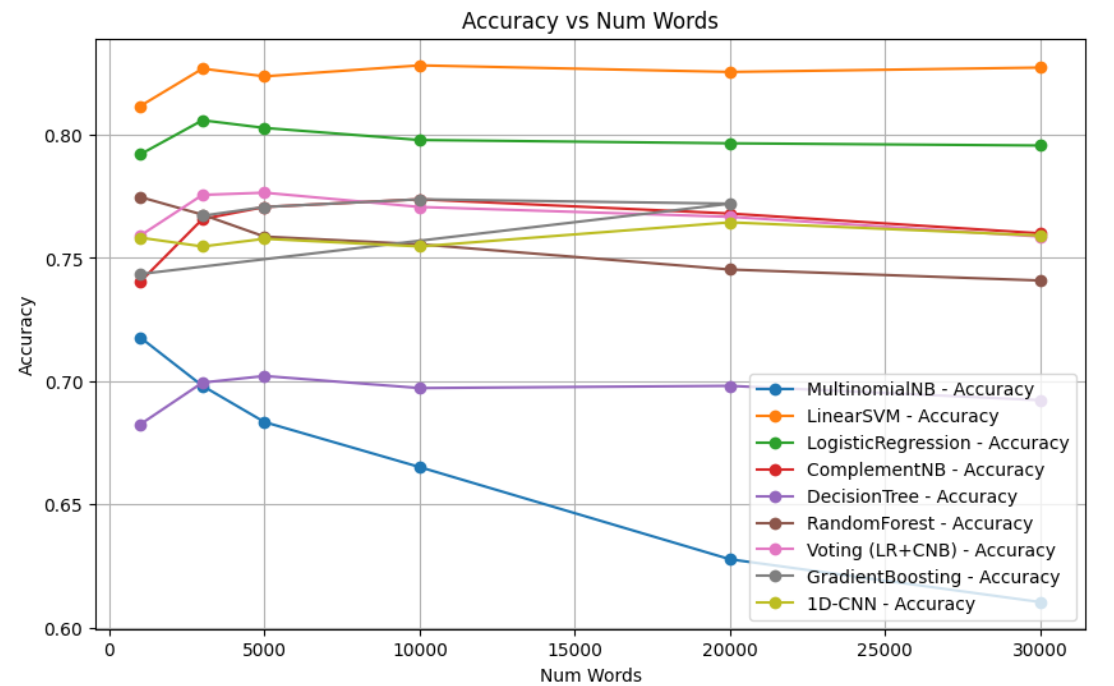
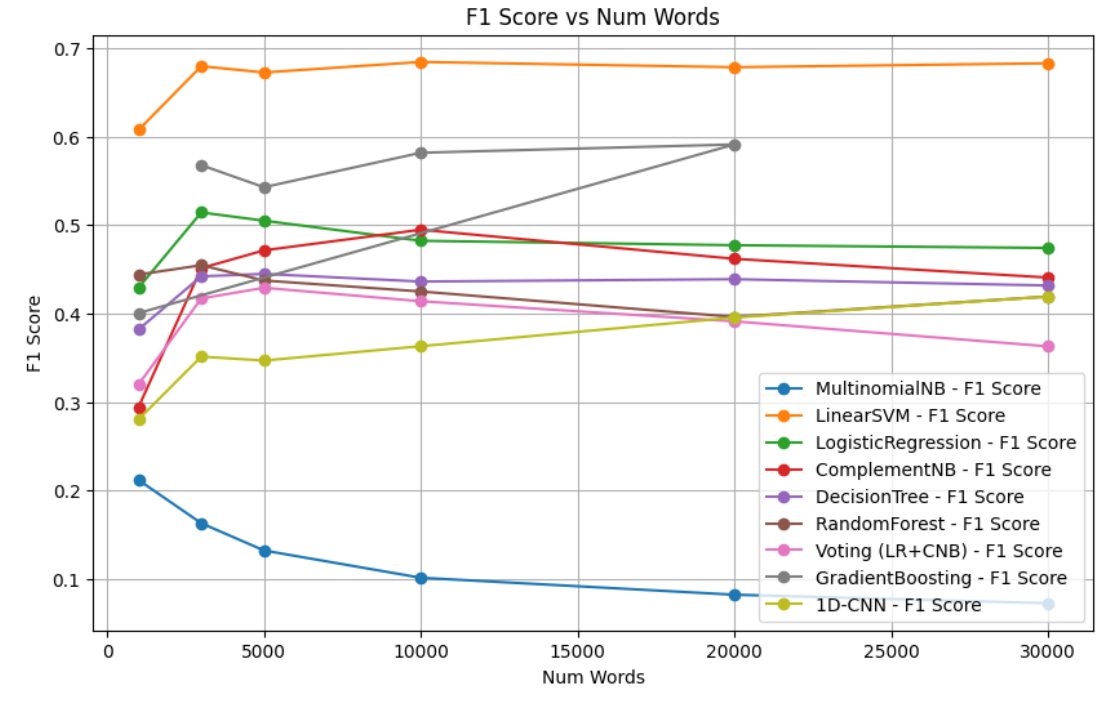
아래는 각 모델들의 vocab size별 Acc와 F1 score이다.
# GradientBoosting 결과 로드 및 concat
gb = pd.read_csv("./Data/gb.csv")

ml_cnn_df = pd.concat([df_final_results, gb, df_cnn], axis=0, ignore_index=True)

# 결과 출력
print("\n[Final Results]")
print(ml_cnn_df.sort_values(by=["Num Words", "F1 Score"], ascending=[True, False]))


[Final Results]
    Num Words               Model  Accuracy  F1 Score
1        1000           LinearSVM  0.811665  0.607671
5        1000        RandomForest  0.774711  0.444068
2        1000  LogisticRegression  0.792075  0.429199
46       1000    GradientBoosting  0.743500  0.400500
4        1000        DecisionTree  0.682547  0.382016
6        1000     Voting (LR+CNB)  0.759127  0.319789
3        1000        ComplementNB  0.740427  0.294183
47       1000              1D-CNN  0.758237  0.280382
0        1000       MultinomialNB  0.717720  0.211673
8        3000           LinearSVM  0.826803  0.679713
42       3000    GradientBoosting  0.767142  0.567806
9        3000  LogisticRegression  0.805877  0.514313
12       3000        RandomForest  0.767587  0.454623
10       3000        ComplementNB  0.765806  0.451319
11       3000        DecisionTree  0.699466  0.442043
13       3000     Voting (LR+CNB)  0.775601  0.417031
48       3000              1D-CNN  0.754675  0.351280
7        3000       MultinomialNB  0.698130  0.162861
15       5000           LinearSVM  0.823687  0.672624
43       5000    GradientBoosting  0.770703  0.542851
16       5000  LogisticRegression  0.802760  0.504996
17       5000        ComplementNB  0.770703  0.471458
18       5000        DecisionTree  0.702137  0.444802
19       5000        RandomForest  0.758682  0.437336
20       5000     Voting (LR+CNB)  0.776492  0.429113
49       5000              1D-CNN  0.757792  0.346800
14       5000       MultinomialNB  0.683437  0.132034
22      10000           LinearSVM  0.828139  0.684512
44      10000    GradientBoosting  0.773820  0.581831
24      10000        ComplementNB  0.773820  0.494775
23      10000  LogisticRegression  0.797863  0.482276
25      10000        DecisionTree  0.697240  0.436168
26      10000        RandomForest  0.755565  0.424958
27      10000     Voting (LR+CNB)  0.770703  0.413891
50      10000              1D-CNN  0.754675  0.363067
21      10000       MultinomialNB  0.665183  0.101184
29      20000           LinearSVM  0.825467  0.678555
45      20000    GradientBoosting  0.772039  0.591218
30      20000  LogisticRegression  0.796527  0.477268
31      20000        ComplementNB  0.768032  0.461880
32      20000        DecisionTree  0.698130  0.438821
33      20000        RandomForest  0.745325  0.396119
51      20000              1D-CNN  0.764470  0.395513
34      20000     Voting (LR+CNB)  0.766696  0.391188
28      20000       MultinomialNB  0.627783  0.082014
36      30000           LinearSVM  0.827248  0.683024
37      30000  LogisticRegression  0.795637  0.474188
38      30000        ComplementNB  0.760018  0.440690
39      30000        DecisionTree  0.692342  0.431723
40      30000        RandomForest  0.740873  0.419206
52      30000              1D-CNN  0.759127  0.419130
41      30000     Voting (LR+CNB)  0.758682  0.362855
35      30000       MultinomialNB  0.610419  0.072340
최종 결과 시각화 및 분석
먼저 함수부터 정의해준다.
import matplotlib.pyplot as plt
import pandas as pd
import math

# 그래프 그리기 함수 정의
def draw_metric_grid(dataframe, metric_name, n_cols=3):
    """
    dataframe: 데이터프레임
    metric_name: 그릴 지표 컬럼명 ('Accuracy' 또는 'F1 Score')
    n_cols: 가로로 배치할 그래프 개수 (기본 3개)
    """
    models = dataframe['Model'].unique()
    n_models = len(models)
    n_rows = math.ceil(n_models / n_cols)

    # 전체 그림 생성
    fig, axes = plt.subplots(n_rows, n_cols, figsize=(6 * n_cols, 4 * n_rows))
    axes = axes.flatten() # 2차원 배열을 1차원으로 펼침

    # 그래프 제목 설정
    fig.suptitle(f'{metric_name} vs Num Words by Model', fontsize=20, y=1.02)

    for i, model in enumerate(models):
        ax = axes[i]
        subset = dataframe[dataframe['Model'] == model]

        # X축 정렬 (Num Words 기준)
        subset = subset.sort_values('Num Words')

        # 선 그래프 그리기
        # x축을 문자열로 변환하여 간격을 일정하게 유지
        ax.plot(subset['Num Words'].astype(str), subset[metric_name],
                marker='o', linestyle='-', linewidth=2, markersize=6)

        # 스타일 설정
        ax.set_title(model, fontsize=14, fontweight='bold')
        ax.set_ylabel(metric_name)
        ax.grid(True, axis='y', linestyle='--', alpha=0.7)

        # Y축 범위 여유 있게 설정
        y_min, y_max = subset[metric_name].min(), subset[metric_name].max()
        margin = (y_max - y_min) * 0.2 if y_max != y_min else 0.01
        ax.set_ylim(y_min - margin, y_max + margin)

    # 남는 서브플롯 제거
    for j in range(i + 1, len(axes)):
        fig.delaxes(axes[j])

    plt.tight_layout()
    plt.show()
(1) Acc

(2) F1 Score

분석
1. 나이브 베이즈 모델
MultinomialNB 모델은 num_words가 커질수록 성능이 크게 하락한다. 하지만, 같은 나이브베이즈 모델인 ComplementNB는 성능이 안정적으로 유지되는데, 그 이유는?
- 나이브 베이즈는 "모든 단어가 서로 독립적"이라고 가정해서 확률을 계산하므로, 단어 수가 많아지면 희소한 단어들이 노이즈가 되어 성능이 하락한다.
- ComplementNB는 희소 단어의 가중치를 보정하는 정규화 과정이 포함되어 있기 때문에, 단어 수가 늘어나면서 노이즈가 많아져도 강건한 성능을 보인다.
2. 선형 모델
LinearSVM의 경우 num_words가 커져도 성능이 안정적으로 유지되거나 상승한다. 하지만 같은 선형 모델인 Logistic Regression은 성능이 하락한다. 그 이유는?
- SVM의 결정 경계는 경계 근처에 있는 소수의 서포트 벡터에 의해 결정되어서 노이즈는 결정 경계에 영향을 주지 않는다.
- 반면, 로지스틱은 모든 data points의 오차를 최소화 하는 방식이므로 노이즈들이 모두 반영되어 성능이 하락하게 된다.
3. 트리 기반 모델
Decision Tree 모델의 경우 num_words가 커져도 소폭 하락하거나 유지되는데, RandomForest는 성능이 하락한다. 그 이유는?
- DT는 정보 이득이 가장 높은 단어만 고르기 때문에 나머지 노이즈들은 무시해서 노이즈에 큰 영향을 받지 않는다. (feature selection 느낌)
- 반면, RF는 여러 개의 트리를 만들어 전체 단어가 아닌 무작위로 일부 단어만 사용해서 학습하므로 num_words가 많아지면 당연히 노이즈를 선택할 확률도 높아지므로 성능이 낮아질 수밖에 없다.
- 그런데 RF 그래프를 보면 num_words 3만개 구간에서 다시 오르는데, 그 이유는?
- 단어 수가 매우 많아지면 약하지만 유용한 피처들이 늘어난다.
- RF는 많은 약한 트리를 모아 작은 신호들을 누적해 최종 성능을 높일 수 있다.
- 그래서 단어 수가 너무 많아도 성능이 다시 소폭 상승하는 구간이 생길 수 있다.
회고
오랜만에 ML 모델들을 다뤄봤는데, GB 학습이 시간을 너무 많이 잡아먹는 것만 제외하면 흥미로운 실험이었다.
각 ML 모델들이 기반하는 알고리즘(NB, Linear, tree)의 특징들을 알아볼 수 있는 시간이었다.
특히 나이브 베이즈 모델에 대해 이론적으로 공부한 적이 없던 것 같은데, 이번에 잘 알게 됐다.
SVM도 학교에서 공부했었는데 흥미를 갖고 한참 들여다본 기억이 난다.
반응형
'AI > NLP' 카테고리의 다른 글
| [11/24] 아이펠 리서치 15기 TIL | Seq2Seq 영-한 번역기 만들기 (0) | 2025.11.27 |
|---|---|
| [11/19] 아이펠 리서치 15기 TIL | WEAT score (1) | 2025.11.27 |
| [11/13] 아이펠 리서치 15기 TIL | Going-Deeper 시작, 형태소 분석기 (1) | 2025.11.21 |
| [11/6~11/11] 아이펠 리서치 15기 TIL | DLthon: 감정 분류 해커톤 (2) (0) | 2025.11.15 |
| [11/6~11/11] 아이펠 리서치 15기 TIL | DLthon: 감정 분류 해커톤 (1) (0) | 2025.11.15 |


